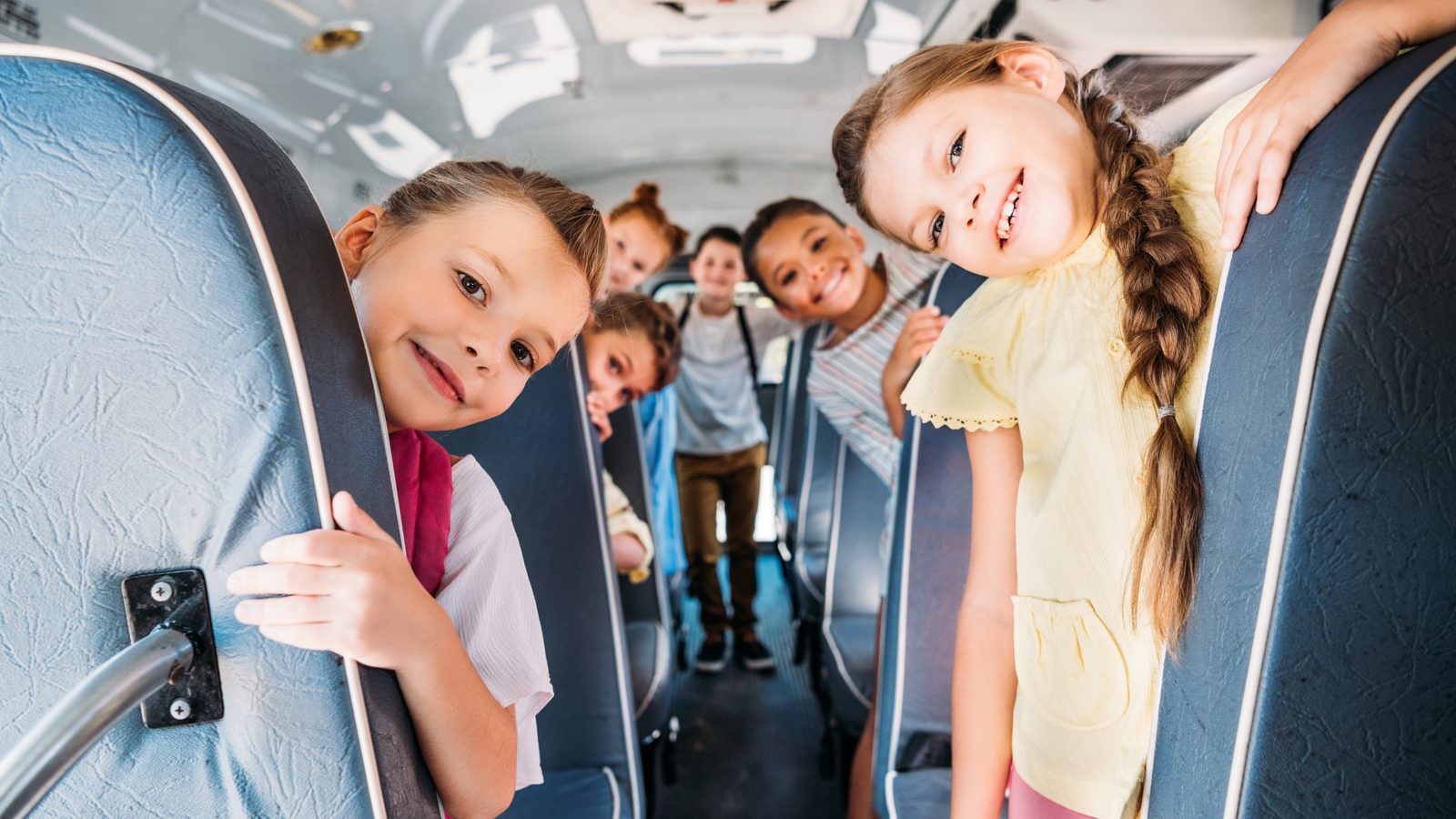
Children get left on school buses when the end-of-route check depends on one tired driver walking the aisle and remembering to look under every seat. An AI child-check system backs up that walk with interior cameras that look for anyone still on board after the route ends, plus student ridership records that show who got on and never got off. If the bus isn't empty, the driver and dispatch are alerted before the bus is locked and parked.
Key takeaways
- Most children left on buses are young riders who fall asleep low in a seat, where they can't be seen from the front of the bus.
- Push-button child-check alarms prove the driver reached the back of the bus. They don't prove every seat was empty.
- S-Vision layers interior AI cameras, RFID or palm-vein ridership tracking and parent notifications so a missed child is caught before the bus is parked.
Why do children still get left on school buses?
Almost every district already has a rule: walk the bus from front to back after every route. The problem is that the rule depends on a person doing the same task perfectly, every route, every day. A young child who falls asleep and slides down below the seat back is easy to miss on a quick walk.
When it goes wrong, the result can be tragic. In 2015, 19-year-old Hun Joon "Paul" Lee, a nonverbal student with autism, was left on a parked bus in Whittier, California, for about seven hours on a 90-degree day and died, according to School Transportation News. Most incidents end better, but they still happen. In July 2026, a Texas district fired a driver after a pre-K student stayed on the bus after drop-off and was found alone in the transportation lot; the district said the driver did not follow child-check procedures (CBS Texas).
Nobody knows the national total, because few states track it. When Indiana began requiring reports in 2009, it logged 135 incidents of children left on school buses in about six years, and a national child-safety nonprofit said Indiana was the only state it knew of that made the data public (WRTV Call 6 Investigates).
Heat makes the stakes higher. The National Safety Council reports that 35 children died in hot vehicles in 2025, and in more than half of these deaths the child was forgotten (NSC Injury Facts). Those figures cover all vehicles, not just buses, but the cause is the same: an adult believed the vehicle was empty.
Staffing adds pressure. In a 2025 AP-NORC and HopSkipDrive survey, 81% of school administrators said bus driver shortages are a problem in their district (AP-NORC/HopSkipDrive via Business Wire). Short-staffed departments run substitutes on unfamiliar routes and put regular drivers on doubled runs, which is exactly when a routine check gets rushed.
“Children being left behind on the bus is more common than people think. Most commonly, children fall asleep lying down in their seat so they can't be seen from the front of the bus. Unfortunately, drivers can forget to perform a walk-through, which can result in panic for families who get a call that their child didn't show up for school.”
Barry Saunders, President, S-Vision
How do traditional child-check alarms work, and where do they fall short?
After the Paul Lee case, California required child safety alert systems that force the driver to walk to the rear of the bus and manually disarm an alarm before leaving (School Transportation News). Many districts in other states use the same kind of push-button system. It's a real improvement because it makes the driver walk the aisle. But walking past a child is not the same as seeing one.
| Approach | What it proves | Gap |
|---|---|---|
| Manual walk-through (policy only) | Nothing, unless the driver logs it | Depends entirely on memory and attention |
| Rear push-button alarm | The driver reached the back of the bus | Doesn't confirm the seats were actually empty |
| AI camera-based child check | Cameras looked at the interior after the route ended | Needs good camera coverage of every seat row |
| Student ridership tracking | Which students boarded and which got off | Works best when every student is scanned on and off |
The strongest setup layers all of them: the driver still walks the bus, and technology confirms the result.
How does an AI child-check system work?
An AI child-check system uses interior cameras and onboard AI to look for a person still on the bus once the route is over. In general, the sequence looks like this:
- The route ends. The system recognizes that the bus has finished its run, for example when it's parked or the ignition is turned off.
- The interior is scanned. Cameras covering the passenger area check for anyone still on board, including low in or between seats.
- An alert goes out. If a person is detected, the driver gets an alert and dispatch is notified, so someone acts while the driver is still nearby.
- The evidence is saved. A timestamped video clip shows what was found and when, which helps the district review what happened and improve training.
Child check is part of the S-Vision school bus safety system, alongside student tracking, parent notifications and 7-zone surveillance of the bus.
How does student tracking add a second layer of protection?
Cameras answer "Is anyone still on the bus?" Ridership tracking answers "Who should have gotten off?" S-Vision's school bus system tracks students as they board and exit using RFID cards or palm-vein scanning, so the district has a record of which students rode, where they got on, and where they got off.
That record matters at the end of the route. If a student scanned on but never scanned off, that's a reason to check the bus again before it's locked. It also gives the office a fast answer when a parent calls asking whether their child made it to school.
Should parents be notified too?
Yes. Parent notifications close the loop. When parents know their child's boarding and drop-off status, a missed drop-off is noticed in minutes instead of hours. S-Vision's school bus system includes parent notifications as part of the same platform.
“It's important for schools implementing this technology that parents are educated on how the alert system works. Parents can be notified through text message or a phone application.”
Barry Saunders, President, S-Vision
What else should a school bus camera system cover?
Child check is one part of a safe bus. The same system should protect students outside the bus and give the district evidence when something goes wrong:
- Danger zones around the bus. The S-Vision school bus system monitors seven zones around the vehicle, and AI pedestrian detection warns the driver about people in or near the vehicle's path.
- Multi-camera recording. An S-Vision MDVR records several cameras at once, inside and outside the bus, so incidents can be reviewed from more than one angle.
- Driver monitoring. The S-Vision AI dash cam flags distraction, fatigue and phone use, the same driver behaviors that also make a rushed end-of-route check more likely. (For more on driver monitoring, see our post ADAS vs. DMS: How AI Dash Cams Stop Crashes Before They Happen.)
- One place to review it all. Events, video and alerts land in SV-Cloud, which also has open integrations with platforms such as Samsara, Lytx and Geotab.
What should a transportation director look for when choosing a child-check system?
- Interior camera coverage of every seat row, including the back of the bus
- An alert that reaches someone other than the driver, such as dispatch
- Saved, timestamped video for each end-of-route check
- Ridership data (RFID or biometric) that flags students who boarded but didn't exit
- Parent notifications that don't depend on the driver making a call
- Compliance with your state's child-check or child reminder requirements
“Camera coverage is critical when implementing this technology. If the camera system isn't installed to see every seat in the bus, kids can be left behind. The second most important item on the list is that an alert is sent to someone other than the bus driver.”
Barry Saunders, President, S-Vision
Frequently asked questions
What is a child-check system on a school bus?
It's a system that makes sure no child is left on a bus after the route ends. Traditional systems require the driver to walk to the back of the bus and press a button to disarm an alarm. AI child-check systems add interior cameras that look for anyone still on board and alert the driver and dispatch.
Why do children get left on school buses?
Usually because a young child falls asleep or stays low in a seat and the driver's end-of-route walk-through misses them. Driver shortages, substitutes on unfamiliar routes and tight schedules make rushed checks more likely.
Are child-check alarms required by law?
Some states require them. California, for example, has required child safety alert systems on school buses since the 2018-19 school year. Requirements vary by state, so check your state's rules.
How does student tracking help prevent a child from being left on the bus?
RFID or palm-vein scanning records which students boarded and which got off. A student who scanned on but not off is a signal to check the bus again before it's parked and locked.
See child check and student tracking on your buses
S-Vision combines child check, student tracking, parent notifications and 7-zone surveillance in one school bus system. Request a demo to see how it works for your district.
Sources
- School Transportation News, California Child Check Law Goes Into Effect (January 2017)
- CBS Texas, Bus driver fired after Crowley ISD pre-K student left on bus (July 2026)
- WRTV Call 6 Investigates, Indiana leading the way in tracking children left on school buses (December 2015)
- National Safety Council, Injury Facts: Hot Car Deaths
- AP-NORC Center for Public Affairs Research and HopSkipDrive, New Data: Bus Driver, Funding Shortages Part of School Transportation Crisis (September 2025)
- S-Vision, School Bus, Pedestrian Detection and SV-Cloud Platform